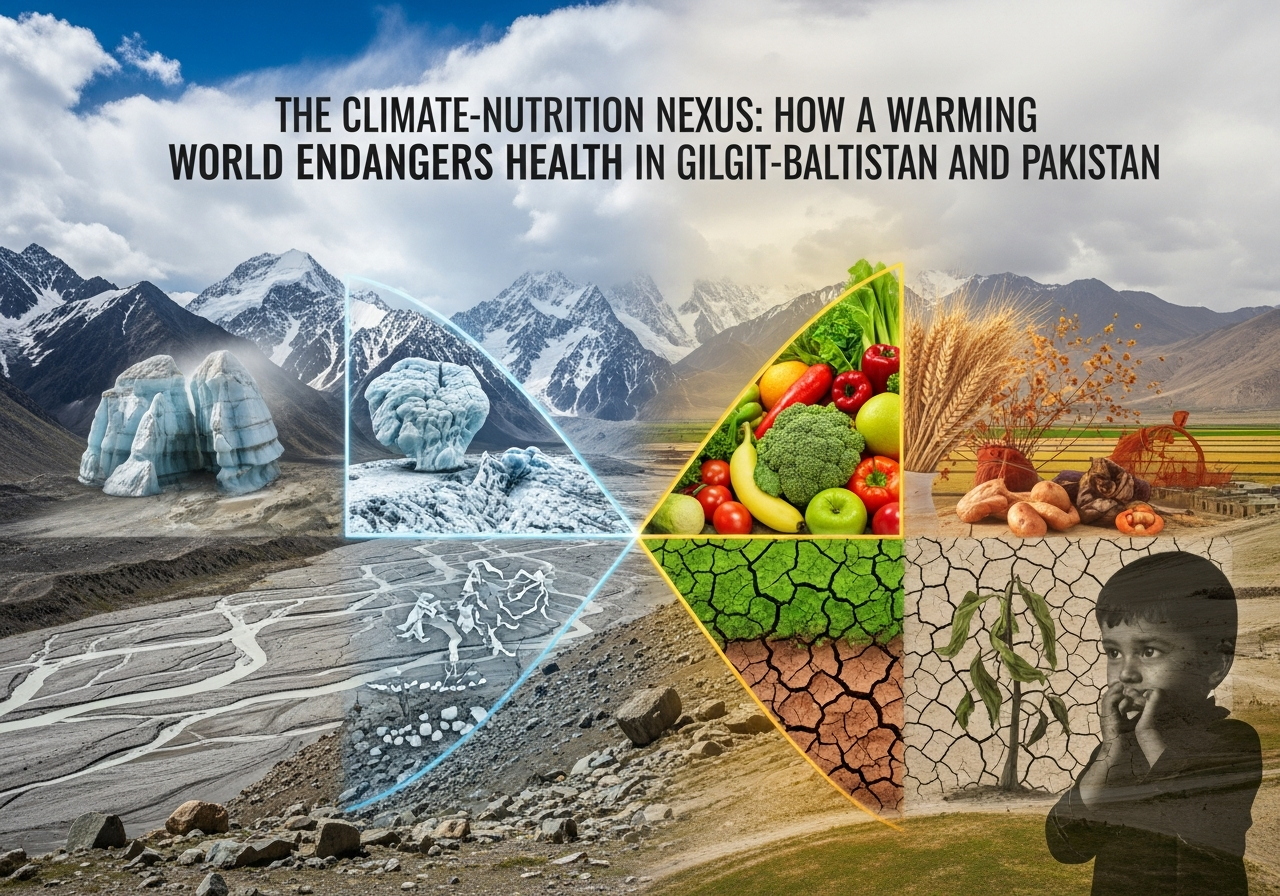
Gilgit-Baltistan, commonly referred to as the water tower of Pakistan, is a place where the highest peaks and largest non-polar glaciers in the world can be found. Farmers in Gilgit-Baltistan are currently observing cracks in the ground and withered harvests on the slopes of the towering Karakoram mountains, where apricot orchards and cherry trees once blossomed consistently and glacial creeks nourished fertile valleys. Consider the case of a family in Nagar District that depended on subsistence farming to earn their daily bread; they now find themselves helplessly standing in the rain as their wheat fields are flooded by erratic rainfall, or enduring the heat as their irrigation lines dry up. This change has struck so much that such stories affect not only one district but also all areas, including Yaseen, Diamer, Hunza, Skardu, Ghizer, and even the main city, Gilgit. Climate change is altering weather patterns and severing the link between food, nutrition, and human health. In Pakistan, a country already facing challenges related to malnutrition, the phenomenon of the climate-nutrition nexus is existential and transforms global environmental changes into local health emergencies. By the end of 2025, the overlap between the growing temperatures, the lack of agriculture, and the lack of nutrition will be more evident than ever. I will attempt to dig into the impact of the clashing forces, supported by new data, and highlight a heart-rending local case of Gilgit-Baltistan. The message? One step, which leads to resilience, is awareness, and the next step should be action.
Discovering the Climate-Nutrition Nexus
Fundamentally, the climate-nutrition nexus refers to the effect of environmental alterations on food systems, which have an impact on human well-being. The increased temperature will melt down the glaciers, causing a temporary surplus and then a catastrophic scarcity. Floods, droughts, and heatwaves destroy harvest crops and pollute water reserves, increasing the cost of food and decreasing food variety. The result? Malnutrition soars, manifesting as stunted growth in children, deficiencies of micronutrients in adults, immunosuppression, and the aggravation of diseases. These shocks are most felt in places such as Pakistan, where agriculture in the area (38% of the labour force) and GDP (more than 20%) are the main sources of income. Protein sources such as livestock are affected by heat stress and lack of fodder, as well as by diseases that are spread by vectors, such as malaria, that are not utilised to disease-controlling organisms, which are living within the changing ecosystems. The UN cautions that, in the coming year 2050, 183 million more people may fall into hunger due to climate change, but in the case of Pakistan, the 8th most climate-vulnerable nation of the past 20 years, it is already dangerously tight.
The Figures Speak an Awakening Story
The latest data of 2024 and 2025 is a dark picture of how this nexus works. The average annual temperature in Pakistan has increased by 0.57°C during the last century, which is higher than the regional average in certain provinces. The rate of rise in Baluchistan was unbelievable, as it rose by 1.12°C between 1960 and 2007. It has already been projected that there will be intensifications of 0.9-1.5°C country-wide in 2025-2050, with potential changes in precipitation already battering food security in such regions as Sindh and Gilgit-Baltistan. The nutrition statistics are even worse; 44% of Pakistani children under the age of five are victims of stunted growth, which is a direct result of the climate-enhanced food insecurity and poverty. In mountainous areas, the effects are even more severe. In a study in Nagar District, Gilgit-Baltistan, in 2024, 87.7% of the farmers reported that climate had adversely affected them, with nearly one-fifth, or a quarter, of farmers reporting a decline in crop yields because of a decrease in irrigation water and an outbreak of pests. The livestock industry, which supports 30 million employments and 14% of the gross domestic product nationally, is exposed to fodder crises that jeopardise 60% of the crude protein consumption of animals, which can reduce productivity by half without intervention. These are not just numbers; they represent families facing hardship, sick children missing school, and marginalised communities. Pakistan has targeted 3.6 billion dollars for adaptation efforts by 2025, but funding deficits remain, leaving rural households vulnerable.
| Key Metric | Value | Source/Context |
| Child Stunting Rate | 44% | Linked to climate-driven malnutrition (UNICEF, 2024) |
| Farmer-Reported Negative Impacts | 87.7% | Crop diseases, water scarcity in Gilgit-Baltistan (Heliyon Study, Nov 2024) |
| Temperature Rise (1901–2000) | +0.57°C | Nationwide average; higher in Balochistan (+1.12°C) (Springer, 2025) |
| Projected Temp Increase (2025–2050) | +0.9–1.5°C | Exacerbating food insecurity (IPCC-aligned projections) |
| Livestock Fodder Deficiency | 60% | Crude protein shortfalls reducing productivity (PMC, 2023–2025 updates) |
A Local Lens: The Struggles of Farmers
To bring this to reality, we shall hone in on Nagar District in Gilgit-Baltistan, which is a high-altitude haven and a hotbed of insecurity. In this case, 80% of the population relies on land-based livelihoods such as wheat, barley, and fruit production, which are nourished by snowmelt from the highest peaks in the world. However, 2025 came as a harsh wake-up call, as record heatwaves of 48.5°C in nearby Chilas and 46.1°C in Bonji on July 5th were followed by glacial lake outburst floods (GLOFs) and monsoon deluges, which swept away orchards and pastures. Consider an example of a low-income farmer, such as Ahmed Khan, whose family has worked the same parcel of land all its life. Irregular monsoons also reduced his apricot crop, the economic saviour of the region, by half last year, and glacier melting reduced the irrigation by 25%. Having fewer varieties of produce, his family began to eat higher amounts of cheaper, less nutritional foods such as rice, which caused them to experience iron deficiencies that caused his young daughter to be anaemic and prone to constant infections. This phenomenon reflects more general tendencies: at Nagar, bivariate correlation indicates that farmers with greater than a decade of experience see the greatest negative changes, with 70% of the yield losses attributed to climate variables. The human cost of the nexus comes into focus with such stories. Isolation and rough terrain, which increase the risks in Gilgit-Baltistan, have pushed food insecurity to new heights, supported by population growth and natural disasters such as the 2025 floods destroying infrastructure and displacing thousands of people. The worst sufferers are women and children, as research has reported increased socio-psychological stress and a barrier to adaptation in such agro-ecological networks as the subaltern.
Ripples Across Pakistan: A National Call to Arms
Although the crisis is best illustrated in Gilgit-Baltistan, the tremors are felt in Pakistan. The livestock herders of Punjab (striving to increase their farms on heat-stressed sheep) and the floods of Sindh (creating waterborne diseases and respiratory difficulties through unseasonal smog) are only the beginning of a 15-20% increase in climate variability. The Third National Communication on Climate Change (2025) cautions that heatwaves, floods, and droughts will increase, with agricultural damages projected to create a 10-15% hit on the GDP by 2030 without any effort to control them. However, there is light at the end of the tunnel in adaptation: community-led resilient crops, such as drought-tolerant millets in Baluchistan, and policy advocacy of nutrition-sensitive climate policies. The Global Climate-Change Impact Studies Centre and WaterAid are engaging in dialogues to lay the food resiliency routes.
Forging a Resilient Future
The climate-nutrition nexus should not be viewed as a mandatory disaster, but rather as a call to action. The farmers in Gilgit-Baltistan and 240 million souls in Pakistan are finding answers to their problems in climate-smart resilience solutions: climate-smart agriculture, fortified food systems, and equal access to health. States should also allocate more funds to the high-vulnerability regions by subsidising irrigation technology and seeds that have high nutritional value, as their international allies should contribute more than the existing amount of 3.6 billion dollars. It is time to begin to act sincerely and genuinely. In Gilgit-Baltistan, environmental concern is a prerequisite to protect the health and nutrition of all of Pakistan and its role in the world. With 2025 coming into view, we can do more than just statistics and narratives; we can create the protection that can transform danger into improvements. What one step can you take? Post it, raise awareness in your community or donate to strategies such as UNICEF Pakistan. Together we can feed a healthier, cooler future.
Sources: Insights drawn from UNICEF Pakistan Annual Report 2024, Heliyon (2024), Springer (2025), and Progressive Climate Foundation (2025)
By Tausif Ahmad
Leave a Reply